
"Quick Wins" are a Myth
Even if they Exist, They're Not Yours to Keep

“I’m a practical guy. I want quick win data & AI use cases!”, the COO of a large bank told me a couple of months ago.
This isn’t the first—or last—time I’ve heard an executive chase “quick wins.” I have been repeatedly asked for “quick wins“ on podcasts, in articles, or over coffee conversations. Every operators seems to wants them.
But here’s the thing, in almost every other context, a “quick win” would be clearly fraudulent, and would raise alarm bells:
If a financial advisor promised to double your money in a month, you’d suspect fraud.
If a nutritionist promised you could lose 15kg in two weeks, you’d know it was dangerous.
If a fitness trainer promised a six-pack in seven days, you’d assume it was either a lie or a health hazard.
Yet, when it comes to data, in business, we chase these same illusions.
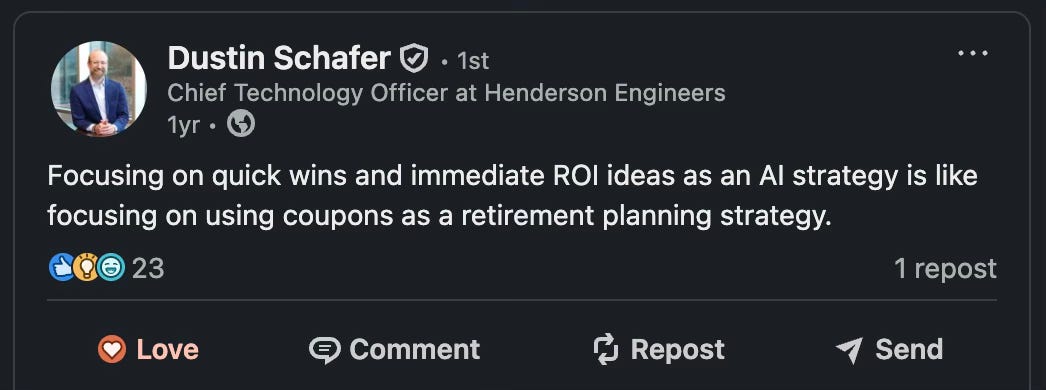
Image Source: Dustin Schafer, Chief Technology Officer at Henderson Engineers
With “quick wins” the only person winning quickly is usually the vendor. You pay them upfront for effort, not outcomes. And even if the initiative succeeds, it’s a one-time payoff for you that doesn’t compound. If you believe that a chain of “quick wins” leads to lasting success, you’re trying to sprint a marathon. You definitely won’t win, more likely you won’t finish the race.
Charlie Munger captured this perfectly in a 1994 speech at USC. He recalled Buffett’s early days in the textile industry, a low-margin commodity business. A new loom promised to double productivity. Buffett wasn’t excited. Why? Because the vendor of the off-the-shelf technology would make money upfront, and any potential efficiency gains would flow entirely to customers. Because a greater supply in a competitive market with a commoditised offering only results in lower prices, as every company in the market buys the off-the-shelf technology. Investing heavily in better off-the-shelf technology would enrich the vendors upfront but create no real advantage for the owners. The lesson is simple but profound: the value of innovation depends on who captures it.
So if you’re not the one winning, why the obsession with something quick?
Broadly speaking, most decisions are either reversible or irreversible.
For reversible decisions, it makes sense to move fast, experiment, iterate, and learn. Speed is useful when failure is inexpensive and feedback is immediate. But speed in this case is only a proxy for learning. The goal is to maximize your rate of learning.
For irreversible decisions, rushing is dangerous. The Navy SEALs mantra should guide execution “Slow is smooth, smooth is fast.”
“Slow is smooth” means acting deliberately and methodically. Your movements are controlled, coordinated, and precise.
“Smooth is fast” means that once you’ve mastered the motion, speed naturally follows. Efficiency isn’t about rushing; it’s about avoiding wasted effort and catastrophic mistakes. Precision creates speed.
Once more it is about your deliberate learning and disciplined execution, there’s nothing quick about it.
“Quick wins” sold by vendors (SaaS, consultants, etc) are a dangerous illusions where the vendor is winning. And being quick is less about speed, but about your rate of learning.
What you really want are big wins.
Big wins are best achieved through compounding, something investors know well. Compounding happens iteratively, over long periods. The key is to identify even a single mechanism with positive externalities that results in a repeatable feedback loop. Then scale it consistently.
In the data-driven digital paradigm, replication costs are zero and decision-making costs tend to zero. Every iteration reduces costs while compounding payoffs. That is how real edge is built. It does not come from stringing together one-off “quick wins” with linear payoffs, which are often distractions or illusions.
So, if quick wins are meaningless, how should you approach building lasting advantage in a competitive market?
One way to think about this rigorously is with the SLASOG framework:
Save
Avoid low-impact strategies and groupthink mistakes. “Quick wins” often distract, sinking resources in things that look good on slides but don’t build lasting value. Saving isn’t just about actual costs, it’s about opportunity costs, attention and focus.
Leverage
Identify and amplify your unique strengths. Compounding advantage comes from doing what only you can do, repeatedly and at scale. “Quick wins” rarely leverage your proprietary strengths, they just enrich your vendors.
Align
Unify organizational effort around a few high-impact goals. “Quick wins” scatter attention and resources. Compounding big wins requires clarity, focus, alignment and coordination, so every unit of effort contributes to an acceleration.
Simplify
Reduce complexity to improve adaptability and speed. “Quick wins” add noise and increase complexity. Even when they work, this leads to higher costs of complexity, which can eventually lead to collapse. Simplicity allows systems to scale efficiently and keeps feedback loops clear, which is essential for iterative improvement.
Optimize
Cultivate an empirically valid worldview and make decisions based on evidence. Don’t chase shiny technology or vendor promises. One-time payoffs are useless in the long-term game of business success. The key is to maximise your rate of learning.
Grow
Focus relentlessly on demand and feedback. Big wins compound when your system is designed to learn and grow. “Quick wins” by vendors exploit one-off opportunities with no path to winning big. Growth multiplies when your flywheel iterates, improves, and accelerates by leveraging your proprietary unfair advantages over time.
Big wins don’t happen by chance or by stringing together one-off “quick wins”. They happen through deliberate, iterative, and disciplined execution. In the data-driven digital paradigm, replication and personalization costs approach zero, while payoffs grow exponentially. That is the essence of compounding advantage.
The lesson is simple: stop chasing “quick wins”. Because they are distractions that rarely create lasting impact. Instead, focus on compounding mechanisms, guided by SLASOG: Save, Leverage, Align, Simplify, Optimize, Grow.
Build winning systems, not one-offs. That is how markets are truly won over time.
For more examples and case studies, refer to my bestselling book Data Impact:
https://www.amazon.de/Data-Impact-businesses-LEVERAGE-SIMPLIFY/dp/178133921X/
I had the honour of discussing these ideas with legendary investor Guy Spier: